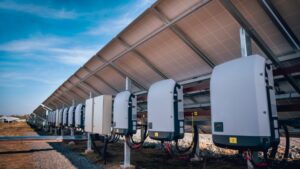

Choosing between a single-phase and three-phase solar inverter starts with the building’s electrical supply. A single-phase inverter feeds power into a single-phase system, which is common in homes and small premises. A three-phase inverter distributes AC output across three phases and is widely used in larger homes, commercial buildings and industrial facilities.
Three-phase is not automatically “better,” and single-phase is not always the cheaper answer once the full installation is considered. The correct choice must match the grid connection, permitted export, load profile, PV capacity and local network rules.

What Does Phase Mean in a Solar System?
Solar panels produce direct current (DC). A grid-connected solar inverter converts it into alternating current (AC) synchronized with the utility supply.
In a single-phase system, one alternating voltage waveform supplies the property. In a three-phase system, three waveforms are offset from one another by 120 electrical degrees. This arrangement delivers power more evenly and can support larger motors and higher total loads efficiently.
The inverter’s AC output must be compatible with the site connection. The PV modules do not become “single-phase” or “three-phase”; the difference is on the inverter’s grid-facing AC side.
Key Differences at a Glance
| Factor | Single-Phase Solar Inverter | Three-Phase Solar Inverter |
|---|---|---|
| Typical site | Homes and small businesses | Large homes, commercial and industrial sites |
| AC output | One phase | Three phases |
| Common load profile | Lower total demand, mostly single-phase loads | Higher demand or substantial three-phase loads |
| Power distribution | Output is placed on one phase | Output is distributed across three phases |
| Installation | Often simpler on an existing single-phase service | Requires a three-phase service and suitable switchgear |
| Capacity | Common at lower residential ratings | Common across larger commercial ratings |
| Main design concern | Phase export and voltage rise at higher power | Phase balance, three-phase protection and grid compliance |
Exact voltage, power and export limits vary by country and distribution network. Always use the local connection agreement and product data sheet.
Advantages of a Single-Phase Solar Inverter
A single-phase inverter is a natural fit when the property has a single-phase utility connection. It often requires less complex AC protection and switchboard work than converting the site to three-phase service.
Typical advantages include:
- Straightforward integration with many residential installations.
- A broad choice of lower-power models.
- Potentially lower equipment and installation cost for a modest PV array.
- Low startup voltage on some models, supporting production in low-light conditions.
- Simple monitoring and maintenance for a small system.
Deye’s single-phase string inverter range is designed for residential and small commercial systems. For example, the SUN-9/10/10.5K-G02P1-EU-AM2 provides two MPPT trackers, a low startup voltage and optional monitoring functions, subject to the model and market specification.
The main limitation appears when PV output becomes large relative to one phase. High current on a single phase can contribute to voltage rise, and network operators may cap single-phase inverter size or export. A three-phase connection may then be required.

Advantages of a Three-Phase Solar Inverter
A three-phase inverter spreads its output across all three phases. This suits facilities with three-phase service and helps deliver power closer to where large commercial or industrial loads use it.
Common advantages include:
- Support for higher PV power levels.
- More even power delivery across the electrical system.
- Better alignment with three-phase motors, HVAC, pumps and machinery.
- Lower current per phase for the same total three-phase power.
- Multiple MPPT channels on many larger models for complex arrays.
- Easier compliance with some network requirements for larger installations.
Deye’s three-phase string inverter range covers commercial, industrial and large-scale systems. Larger products such as the SUN-120/125/130/135/136K-G01P3-EU-AM8 offer multiple MPPT trackers and protection features for substantial PV arrays.
A three-phase inverter may cost more and requires compatible metering, protection and cabling. If the property only has single-phase service, upgrading the utility connection can add cost and lead time.
Does a Three-Phase Inverter Produce More Solar Energy?
Not by phase type alone. Annual energy yield mainly depends on PV array size, irradiance, shading, orientation, temperature, MPPT design, conversion efficiency and system availability.
A three-phase inverter can make a larger project practical and may reduce constraints related to current or voltage rise. Those system-level benefits can increase usable output in a particular installation. But changing a correctly sized single-phase inverter to a three-phase model does not create extra sunlight.
Compare efficiency at realistic operating points and review MPPT quantity and voltage range for the planned string layout.
At a three-phase property, loads may be uneven and metering rules vary by market. Ask the installer to measure phase loads and confirm how the utility treats simultaneous import and export. Where export is limited, compatible meters and zero-export controls must be commissioned correctly.
What About Hybrid Inverters and Batteries?
The phase decision also affects backup and storage. A single-phase hybrid inverter may back up selected single-phase circuits. A three-phase hybrid system can support three-phase loads, but motor starting current, phase imbalance and backup output limits require careful design.
Not every three-phase inverter can operate a three-phase motor during an outage. Grid-tied string inverters normally shut down when the grid fails unless a compliant backup architecture is installed. If backup is required, define which loads must run, their starting demand and the required runtime before selecting the inverter and battery.
Browse Deye’s full solar inverter portfolio to compare string, hybrid and other inverter types.
Which Inverter Should You Choose?
Choose a single-phase inverter when:
- The utility connection is single-phase.
- The PV array and permitted export fit local single-phase limits.
- The loads are modest and mainly single-phase.
- A service upgrade would not provide enough added value.
Choose a three-phase inverter when:
- The building already has three-phase supply.
- The solar system is too large for local single-phase limits.
- Significant three-phase loads operate during solar hours.
- Phase balance, current levels or voltage rise favor three-phase output.
- The network operator requires it for the proposed capacity.
Some low-voltage networks use different three-phase configurations. Deye also offers a dedicated three-phase low-voltage string inverter range. Match the model’s rated output voltage and grid certification to the exact site; “three-phase” by itself is not enough.
Information Your Installer or Supplier Needs
Provide the country, grid voltage and frequency, service phase, proposed PV capacity, module data, roof orientations, shading and string layout. Add interval load data by phase where available, the export limit, backup requirements and details of large motors. Installation conditions and required monitoring also matter. The installer should complete cable, protection, voltage-rise and short-circuit calculations and confirm local certification.
Match the Inverter to the Connection and the Load
The central difference between a single-phase and three-phase solar inverter is how AC power is delivered to the building and grid. Single-phase models are usually the practical choice for modest systems on single-phase service. Three-phase models suit larger or three-phase-connected sites and distribute power across the phases.
Need help selecting an inverter for your project? Visit the Deye Contact page, select Inverter, and submit the form with your grid details, PV array size, load profile, export requirements and backup needs. Our team can use this information to help identify a compatible model instead of relying on kW rating alone.